Notes from five years engineering forest restoration
Pascal Asselin · 2026-05-26 · 14 minutes
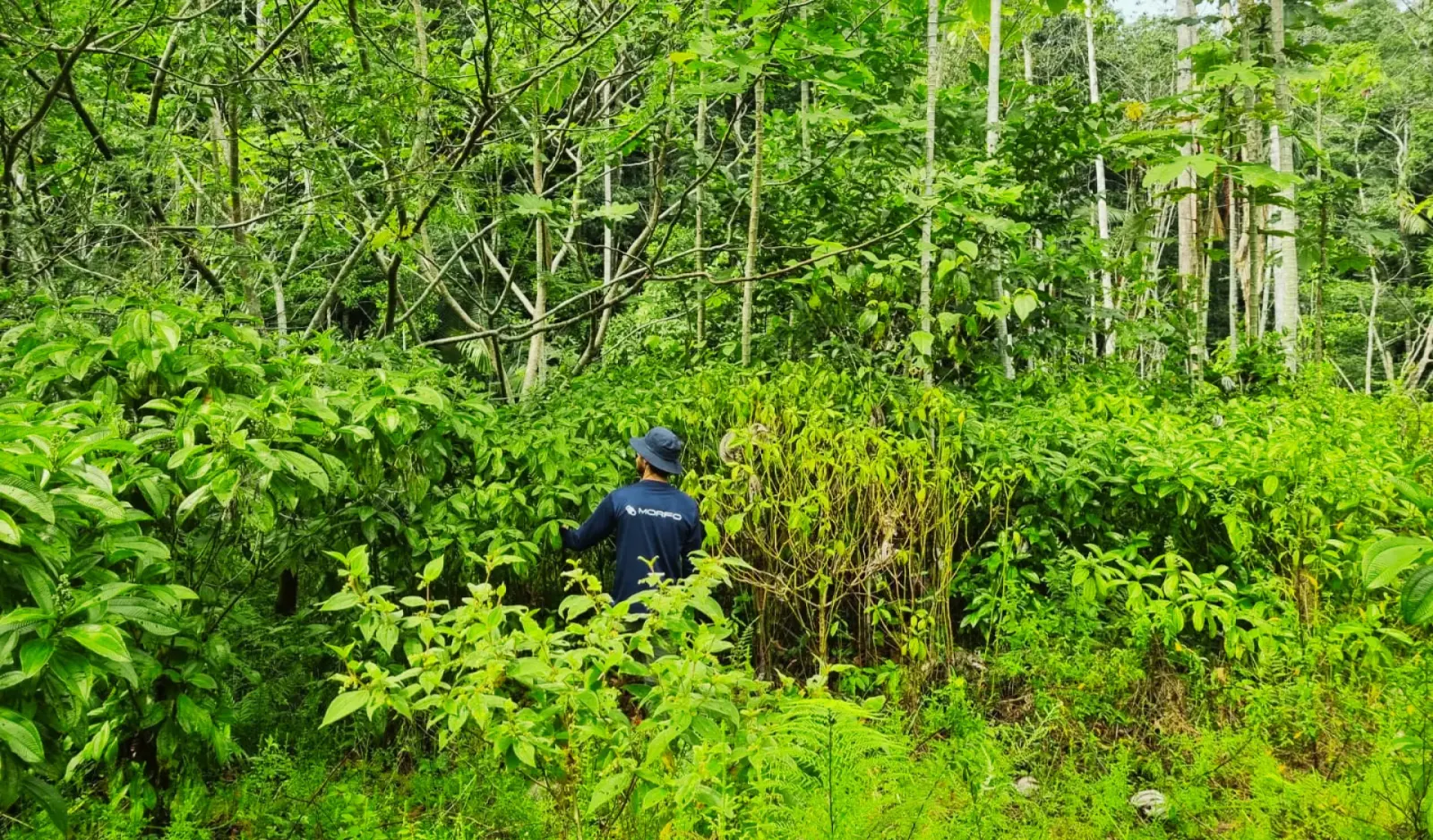
On May 25, 2026, MORFO turned five.Five years building the technical tools that help corporates, funds and project developers restore native forests by the thousand hectares. The why and the what from 2021 haven't changed. But the path wasn't the one we imagined at the start.
What follows is the story.The milestones, the mistakes, the lessons and what we think comes next.
Where it started
My father was a gold miner, first in Brazil, then in French Guiana. Hugo, my brother, and I had spent our childhood on his mining sites, in areas where the activity eventually left behind bare soil.
 Standard toy when your dad runs gold mines
Twenty-five years later, in late 2020, a Christmas conversation brought Hugo and me back to one question: why weren't mining sites being properly restored? Pressure was building with regulators tightening, corporate commitments multiplying. Yet, companies looking for a real answer had nowhere to turn. The work was technical, expensive, slow to mature. No operator was built to deliver it.
And it wasn't just mining. Industrial sites, post-agriculture, degraded pastures: all of them carried serious technical challenges, at scales that made your head spin.
On May 25, 2021, we received the registration papers. MORFO (for "** MORe ** FOrest" and for the Morpho butterfly, of course) was born. The mission : restore the best native forests at scale.
 With dad. The snack was non-negotiable.
What we built first
We started with two axes.
The first was science, through our collaboration with IRD, INRAe and CIRAD in Montpellier (France). The goal was concrete: understand how plants interact with soil micro-organisms so we could restore severely degraded land where roots don't naturally take hold, and select the right species mix, micro-organisms and nutrients for each biome. That work led to the seed encapsulation technology behind every hectare we plant today.
The second was engineering. To restore ecosystems at the scale degradation requires, manual planting hits a wall fast. A trained team covers a few hectares per day. We needed to multiply that. So we worked with partners to develop our own direct-seeding drones, and industrialised the seedpods production. 50 hectares per day per drone. 180 capsules per minute, around 600 seeds per minute. A speed nothing else could match, at meaningful cost.
We built something that worked. Our drone direct seeding system could restore severely degraded land at a speed nothing else could match, and at meaningful cost. In the right conditions (and not under any conditions) it could do wonders.
Restoration of a former alluvial gold mine in the Amazon, heavily polluted and stripped of vegetation. A technical success, validated by the environmental authority just three years after planting. A source of reusable data for us, but not an automatic path to scaling.
The wrong question
We thought we were answering the two challenges our clients cared about most: cost and scale.We were wrong. Cost reduction, yes, everyone wanted that (who wouldn't!). But scale wasn't the question. Most projects were still at the pilot stage and didn't need to plant that fast back in 2022-2023. And we hadn't opened our eyes on something else.
In Brazil, I learned the expression arroz com feijão. Rice and beans, what you eat every day, basic, reliable, done well. That's what buyers wanted, and they had good reasons. For decades, ecosystem restoration has been done using what is widely seen as the most controlled approach: manually planting seedlings in rows. Decades of experimentation, optimization, and accumulated knowledge behind it. It's not always the best method everywhere. It's not always the cheapest. But it has a track record. And track record is what convinces a buyer to sign.
We arrived with a drone and direct-seeded the entire area, 15 to 30 species per hectare. The result looked closer to what a forest does naturally, but it didn’t match what the market had been trained to expect. No neat rows, no familiar metrics, no decades of comparable projects behind us. As innovative as our approach was, it didn’t give them the reassurance they needed.
So we fought a problem of adoption. And we fought it for years. We spent our days proving, building graphs, taking people to visit our sites to show that the technique worked. 90% of the questions we were asked were about technique. "What's your survival rate?" "How many hectares per day?" , “What's inside the seedpod?”. We were locked in a planting-technique debate, drone direct seeding versus manual seedling planting.
By 2024, we had started working with the largest Brazilian corporates and with project developers. Large contracts. Concrete problems.
But the scale still wasn't there.
Little by little, we understood something we hadn't seen before. The planting technique was the how. What was missing was the why.
Solving the risk-return equation
Talking with a lot of great people (to those who'll recognize themselves, thank you!), the picture became clearer and clearer. Restoration isn't slow because the planting technique isn't ready.
It's slow because, from the point of view of the people making the decisions, the project itself looks unbankable.
From the perspective of an investment committee or top management, native forest remains a low-return, high-risk asset. ** Low return** because monetizable revenues (compliance, carbon, timber, non-timber forest products like cosmetics and food ingredients, ecosystem services...) arrive late, are volatile, or don't cover the opportunity cost of capital. ** High risk** because results only materialize after years and a forest carries every uncertainty inherent to a natural system. As long as that equation stays open, projects stay in a Powerpoint.
So our objective evolved. We had to find ways to solve this risk-return equation. The answer was predictability. And we realized we couldn't do it from the sidelines. As operators, ** we had to take a share of the risk ourselves.** Banks are starting to underwrite restoration. Insurers are launching parametric products. Project developers are taking on mezzanine guarantees that put their own balance sheets at risk. If we want this market to exist, the people on the ground, the ones putting the seed into the soil, can't sit out the risk conversation. ** Someone has to be accountable for field outcomes. We chose to.**
Practically, that meant two things.
- First, changing what we measured for. We went back through every project we had ever run, our sites at the time, and extracted every piece of usable data.
- Second, building predictive models. Not as a marketing layer, but as the foundation for how we price and commit to performance.
MORFO Restoration Intelligence, an engine powered by field data to design the best planting strategies and track them, zone by zone
Concretely, what we do today
MORFO now operates two interlocking business lines.
Restoration intelligence. Our proprietary models run a satellite pre-analysis: areas of interest, risks, cost estimates, zones to rule out. What passes the filter goes through a field diagnostic (drone & soil) that builds a restoration plan, zone by zone. The result: hundreds of precise decisions per site, 30–50% cost cuts versus a uniform approach, predictability, and a certification-ready evidence package from day one.
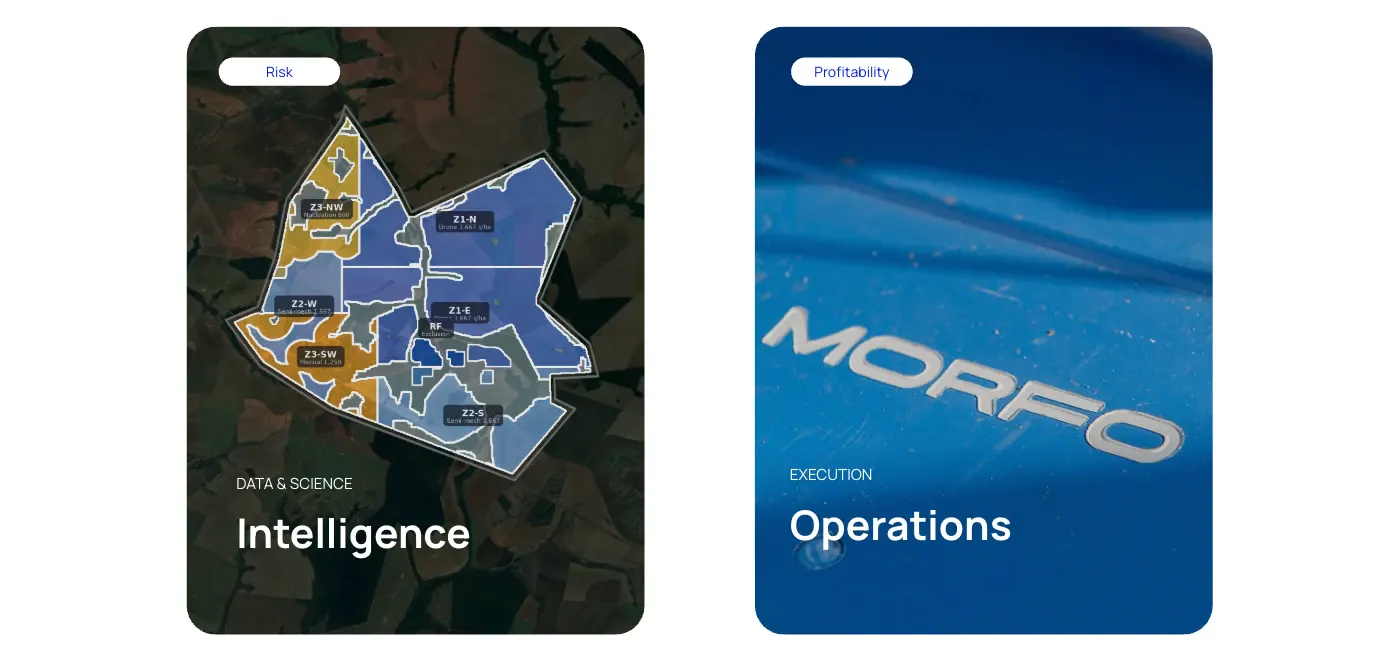
As a result, we can now offer a performance-based pricing model.We don't sell efforts. We commit to KPIs. Data isn't a solution in itself, but it gave us the confidence in our models to do this. It's predictability. And it's the recognition that for this market to work, someone has to take responsibility for outcomes. So we do. Performance guarantees, with unlimited corrective actions until KPIs are achieved.
Which opens up a new type of conversation with our most advanced clients**.**
 MORFO Restoration Intelligence, an engine powered by field data to design the best planting strategies and track them, zone by zone
What's still ahead
Five years in, the foundations are set. Now we build on them.Most of the projects above are still being structured. Some will land, others won't. We know that, and we plan for it. And, of course, restoration carries surprises, that's its nature. BBut what we built makes them fewer, smaller, and easier to absorb.
We came to believe the bottleneck isn't the technology or the data in themselves, but what they unlock: predictability and commitment.That's what lets the people writing the checks price what they're buying and see a return.
+5 years, in figures
- +2,142 hectares in restoration across ** three biomes in Brazil**
- 27 projects with leading clients such as Suzano, Hydro, Mosaic, the city of Rio de Janeiro, and others we can't name yet
- +490 native species in our catalog, with 30 to 40 key species per biome to adapt every species mix
- 1,500 people involved in our seed collection network
- 10 research programs with Embrapa, UFV, UFSCar, IRD, and others
- 2 integrated business lines: MORFO Restoration Intelligence (our internal platform to diagnose and plan zone by zone) and field Operations (soil prep, planting, maintenance, monitoring).
- 1 performance-based pricing model: we don't sell efforts, we sell results. Contractual performance guarantees, with unlimited corrective actions until KPIs are met.
PS : A huge thank you to everyone who is part of this mission, who has been, or plans to be. The team, the partners, the clients, the investors, the curious, the people who just follow along, those who helped me write and review this article (summing up five years isn't easy, trust me). The seeds are in the ground.Let's grow.